THEY'RE GROWING UP. LET'S GIVE THEM SKILLS FOR WHAT COMES NEXT.
Friendships are changing. Emotions are getting bigger. Social media is entering the conversation. And your child is beginning to make more decisions without you standing right beside them.
Emerging Relationships gives 10-12-year-olds a supportive, age-appropriate place to practice communication, confidence, emotional awareness, healthy decision-making, boundaries, and relationship skills before the stakes get higher.
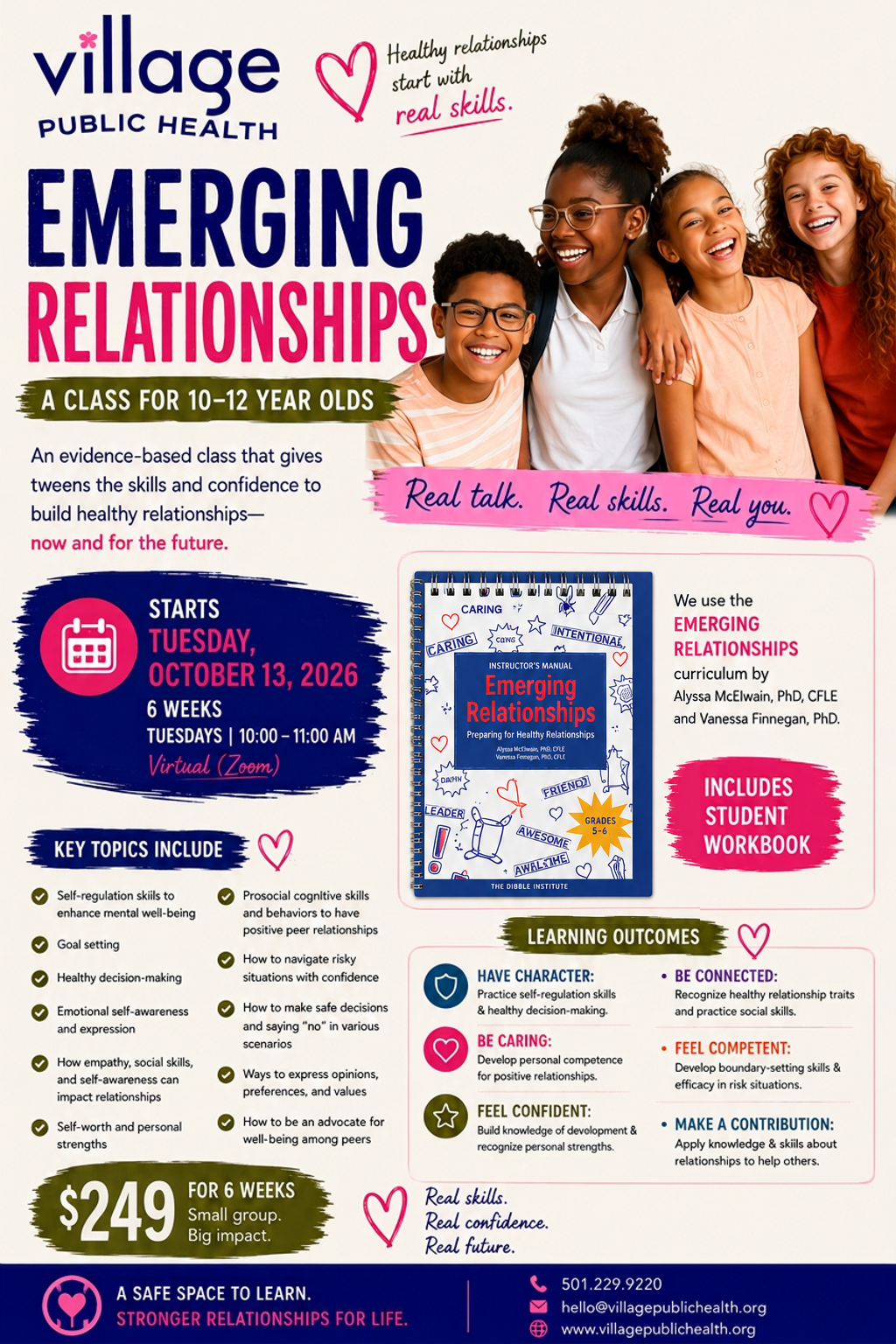
6 Weeks
Tuesdays, 10-11 AM CT
Virtual
October 13, 2026
10-12
$249 · Workbook Included
PRICING
ONE PRICE. EVERYTHING INCLUDED.
$249
Full six-week cohort, per student.
- Six live virtual sessions, Tuesdays 10-11 AM CT
- Printed student workbook included
- Weekly at-home discussion prompts for parents
- Start and end-of-cohort skill summaries
- Led by a certified health education specialist (CHES)
YOU'RE NOT ALONE IN THIS
IF YOU'VE BEEN WONDERING…
YOU DO NOT HAVE TO WAIT FOR A CRISIS TO TEACH RELATIONSHIP SKILLS. THIS IS PREVENTION.
We create space for young people to practice these skills now, while parents and trusted adults are still close enough to help reinforce them.
FROM WORRY TO SKILL
WHAT KEEPS YOU UP AT NIGHT. WHAT WE TEACH.
They go along with the group instead of speaking up.
Refusal language, assertive phrasing, and practice saying no without over-explaining.
Your child has words ready before the moment happens.
Big feelings turn into shutdowns or blowups.
Self-regulation strategies, naming emotions, and pause-and-choose decision steps.
Your child can name what they feel and choose a next step.
Group chats and social apps are pulling them in.
Digital boundaries, what is private, and how to exit an uncomfortable conversation.
Your child knows when to step away and who to tell.
I don't know how to start these conversations at home.
A student workbook with reflection prompts you can use together each week.
You get a natural opener instead of an awkward talk.
Friendships feel one-sided or unkind.
Traits of healthy versus unhealthy friendships, empathy, and repair skills.
Your child can tell the difference and act on it.
I want values reinforced, not replaced.
Skills-based, age-appropriate content; families stay the primary voice on values.
You stay in the driver's seat.
CURRICULUM FOCUS
SIX WEEKS OF SKILLS THEY CAN ACTUALLY USE
- Self-regulation skills to enhance mental well-being
- Goal setting
- Healthy decision-making
- Emotional self-awareness and expression
- How empathy, social skills, and self-awareness impact relationships
- Self-worth and personal strengths
- Prosocial cognitive skills and behaviors for positive peer relationships
- How to navigate risky situations with confidence
- How to make safe decisions and say no in different situations
- Ways to express opinions, preferences, and values
- How to be an advocate for well-being among peers
WHAT YOUR CHILD GAINS
LEARNING OUTCOMES
Have Character
Practice self-regulation skills and healthy decision-making.
Be Caring
Develop personal competence for positive relationships.
Feel Confident
Build knowledge of development and recognize personal strengths.
Be Connected
Recognize healthy relationship traits and practice social skills.
Feel Competent
Develop boundary-setting skills and confidence in potentially risky situations.
Make A Contribution
Apply knowledge and relationship skills in ways that support others.
THE CURRICULUM
NOT JUST CONVERSATION. A STRUCTURED LEARNING EXPERIENCE.
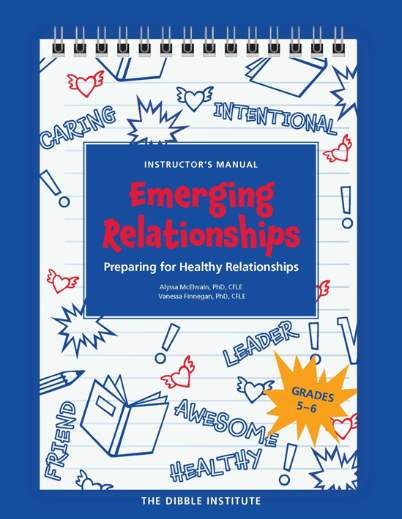
Emerging Relationships: Preparing for Healthy Relationships is an evidence-based curriculum from The Dibble Institute, authored by Alyssa McElwain, PhD, CFLE, and Vanessa Finnegan, PhD, CFLE, and designed for students in grades 5-6.
Each registered student receives a workbook so learning does not stop when the virtual session ends.
LEARN
Understand the concept.
PRACTICE
Apply it through activities and conversation.
REFLECT
Use the student workbook to connect learning to real life.
ARKANSAS FAMILIES AND EDUCATORS
LEARNING WITH PURPOSE
Designed to complement learning goals important to Arkansas families and educators, Emerging Relationships supports Healthy Skills and Relationships priorities, including:
- Effective communication
- Interpersonal skills
- Healthy decision-making
- Personal well-being
- Relationship skills
- Boundary-setting
- Digital and social-media safety
Village Public Health, Inc. is an EFA-approved provider. Families should confirm current eligible expense categories with the Arkansas Department of Education, as EFA policy can change between school years.
A NOTE FOR PARENTS
AGE-APPROPRIATE BY DESIGN
This is relationship education for 10-12-year-olds. The focus is not adult dating. The focus is helping young people understand themselves, communicate effectively, recognize healthy relationship qualities, make thoughtful decisions, respect boundaries, navigate peer situations, and develop skills that grow with them.
WHAT IT COSTS
$249 FOR THE FULL COHORT. NO ADD-ONS.
That is roughly $33 per live session, workbook included. Families pay the fee; Village Public Health, Inc. is an approved Arkansas EFA vendor and does not provide funds. If your student has an Education Freedom Account, you can pay through ClassWallet or submit your receipt for state reimbursement. Confirm current eligible expense categories with the Arkansas Department of Education.
- 6 live virtual sessions with a certified health education specialist (CHES)
- Official Dibble Institute student workbook shipped to your home
- Weekly at-home discussion prompts for parents
- Group expectations that protect student privacy
- End-of-cohort skills summary for your records
PARENT QUESTIONS
HONEST ANSWERS BEFORE YOU ENROLL
Is this sex education?+
No. This is healthy relationships education for ages 10-12. The focus is communication, emotions, friendship quality, boundaries, and decision-making. There is no dating instruction and no clinical content.
Can EFA funds cover the cost?+
Families pay the class fee; Village Public Health, Inc. is an approved EFA vendor and does not provide funds. If your student has an EFA, you can pay through ClassWallet or submit your receipt for state reimbursement. Confirm current eligible expense categories with the Arkansas Department of Education, because EFA policy can change between school years.
What does my child actually do each week?+
One live virtual hour on Tuesdays at 10 AM CT for six weeks, plus a printed student workbook for reflection between sessions. Sessions are led by a certified health education specialist.
Will my child have to share personal information in a group?+
No. Participation is skills-based. Group expectations are set in week one, students are never required to disclose personal or family details, and recording or sharing another participant's image or words is not permitted.
My child is shy. Will they be put on the spot?+
Students can participate through chat, small activities, and workbook reflection. Nobody is forced to speak on camera.
What if we miss a week?+
Registration covers the full six-week cohort. Tell us in advance and we will send the workbook pages and a short recap so your child can stay on pace.
How will I know it worked?+
You receive a start-of-cohort overview, weekly at-home discussion prompts, and an end-of-cohort summary of the skills your child practiced.
NOT READY TO REGISTER?
ASK US A QUESTION
Tell us a little about your family and how to reach you. We'll follow up with answers about Emerging Relationships, EFA, scheduling, or anything else on your mind.
REGISTRATION
RESERVE YOUR CHILD'S SPOT
$249 includes 6 live virtual sessions, the official student workbook, interactive activities, small-group learning, and parent orientation information. Space is intentionally limited.
STEP 1 OF 5